Showing posts with label movie. Show all posts

Monday, October 10, 2011

Undefeated


For any of you brave souls who are curious enough to risk the fear of disappointment...watch this movie. I think you'll be surprised how dry and candid it is, as well as intriguing? It's oddly cathartic, if you just want to get the poison of the media out of your system.

It's power is in its simplicity. It's not a pity party or dramatic hagiography.

Instead, it gets pretty nerdy focusing half the movie on why Alaska is important, how Palin got to the governorship and what she did, how she started out as a mayor, when she resigned her six-figure-salary as an ethics commissioner because of her ethics, how she surprised people with actual results and then America by showing up in 2008.

The power of the documentary is that while extrinsically focused around Palin--is intrinsically not about Sarah Palin. The film doesn't even seem to focus on her personal achievements enough and get the audience more drawn in when it could, but focuses on her beliefs in God and America, and the role of the government--shared similarly by many in the tea-party movement--and her actions in carrying that out.

If it was supposed to make you vote, it didn't really hype on possible terrorist threats, wars, or abortion--things I think Obama is weak on and Palin is strong in--and very emotionally topics that could rouse voters. I was surprised how little they talked about Obama (like less than 2 minutes? of actual speeches) which seem to convince me that others could do a much better job than him. What the film did was focus on a cause that is greater than Palin, the Tea-Party movement or America. It's about Faith. Palin's very persecution from the mobs of media and hollywood from just about every vocal or artistic profession--she shows us how, we too, can and will be treated if we take a stand for just a little bit of truth, righteousness, and faith in God.(scary) Yet this small person's courage shows us a greater power when we fight for a greater cause. Now that's why liberals are scared of her. Obama and Palin have shown us that we can become self-proclaimed messiahs, or modern-day-martyrs. Persecution in this world, and in this time, shows us that we are on the right path. Let us choose to lose our lives, that we may gain it--for only then are we the "undefeated."

Sh'ma Yisrael! God bless America.

Thursday, October 7, 2010

The Cranes Are Flying

I just saw The Cranes Are Flying (1957 Russian) last night and got to cry. I've been browsing Anne Frank and Holocaust memorials and downloaded the movie Crossing about North Korea. I don't why, but I've been having trouble concentrating during classes or studying lately...I've been writing poems in Physics class...it seems that's the only time I write anything interesting. Sigh. Anyway, The Cranes Are Flying is a GOOD movie. It is about what happens to a country or families during a war, how there is so much destruction and loss and yet having the strength to still hope and love and hold no bitterness or hatred. The actress is looks a little bit like Larissa in The Cruel Romance (Zhestokiy Romans) only she is so 1950s--innocent and good. This girl reminds me a little of St. Bernadette in The Song of Bernadette. Anyway, I also recommend that film, as well as Crossing. How beautiful and good are these stories that have so much pain and yet so much hope and belief in the eternal!

Wednesday, March 17, 2010

Lent day 25: Crossing


Yesterday I watched this really sad movie about North Korea called Crossing. I'm afraid all my little relatives were a little traumatized... But I do recommend it of course, considering that it is the first of its kind to talk about North Korea. The Voice of the Martyrs magazine says it is not very violent, though this is obviously comparative to reality, especially if you know or read anything about North Korea and communist concentration camps, which I have. If you have, than I think you would find this movie subtle, sweet, and sad. (I refrain from saying sentimental because I think sentimental implies a happier ending.) If you haven't read anything about North Korea or concentration camps than I think that you may find this film a little disturbing and depressing.
I think what makes movies so bittersweet and sentimental is because as a movie, it can only give a fraction of reality, and though reality can be much more ugly, reality somehow is able to be 3-D, giving you a dimension into the eternal in much better terms...That is, just as relieving as it is that no real actors got killed or tortured, you are not able to have the true ability to see eternally, because real faith and power only comes in great need--not on a camera set... (of course I am not suggesting torturing actors because it is like testing quantum mechanics)
Like quantum mechanics, faith is hard to experiment on... Doesn't it say "You shall not test the Lord your God"? So we are only able to give some of the ugliness, and part of the beauty--which is hard to satisfy because ugliness is easy to test and ask for, but beauty--true beauty is a little harder.

Thursday, December 3, 2009

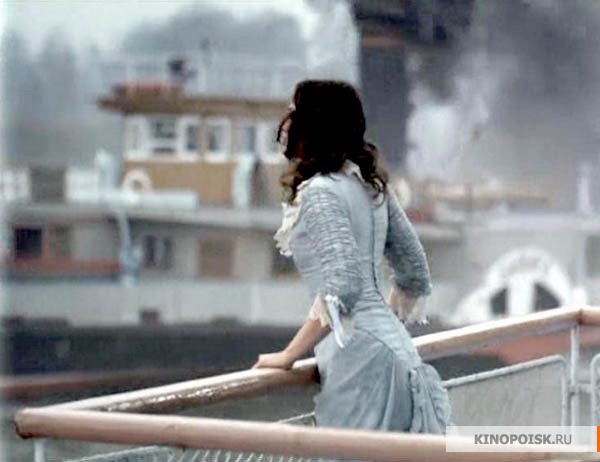
movie review: Zhestokiy Romans 1984


This is another Russian movie, based on a 1840's play The Dowerless Girl by Ostrovsky. I am told that this film is very close in detail to the play but completely different in spirit. I think it was a very popular film in Russia. This film is very beautiful with its stellar cast, real characters, catchy gypsy melodies, and subtle cinematography. This film is not for everyone, except perhaps if you are the type who finds depressing 19th century soap operas cathartic or just enjoy a good cry.
The story revolves around an upper-class girl with no money trying to find a suitor during a tumultuous time period seeing the end of serfdom, rising middle class, and downfall of nobility.
This story is the type of "novel without a hero" drama, with suitors who are either are suave, petty, disgusting, pitiful, or a little of each. All of the characters are human, to some degree sympathize-able, and no character is a sacrificial lamb or cardboard-cutout. Overall, the cast and screenplay are impressive, not because they convince you so well that they are from a different time, but because they convince you that there is no such thing--that it is your own.
What amazed me most was how the film transformed a sorrowful tale of political and social upheaval into a universal tale about people's inability in search for eternal, unconditional human love---particularly about woman's innate and irrational desire for eternal, unconditional, and fulfilling love, often thought to be found in men or marriage.
It is odd how so many girls think that they can prove their mothers wrong, or are even encouraged by their mothers to think that their mothers' situation is exceptional or amendable.
Their mothers' situations are not exceptional, nor amendable, because their problem is not from situation--it is from within. We are our mothers. We are Eve. And our desire shall be for our husband, and he shall rule over us.
No, fulfillment cannot come from humanity, from human love, from humanistic ideals or idealistic humanism.
Idealistic humanism is ultimately idolatrous, because it is searching for fulfillment within. I think it is sad that what Hollywood pretends and promotes is also what many Christians in America seem to buy, sell, and worship. But what you make or buy cannot eternally satisfy, for they are only dead images carved by men; they have ears but cannot hear, mouths, but cannot speak.
For some reason it seems that true idealism, or belief in the beautiful unseen, only works when there is faith in the beautiful, everlasting, all-powerful, just, self-sustaining, and unseen purpose. Somehow, finding purpose in present life or mankind is futile, yet so many have succeeded only when they did not believe and rely on the present, but on the eternal.
When man searches within, he is empty. When man searches without, he is full.

"Let nothing disturb thee; Let nothing dismay thee; All thing pass; G-d never changes.
Patience attains All that it strives for. He who has G-d finds he lacks nothing: G-d alone suffices." --st. Theresa of Avila

Monday, August 24, 2009

movie review: crime and punishment 1969


I've been searching youtube for a good Crime and Punishment film for a while, and I think I've finally found one worth watching, meaning of course, that it doesn't try to re-write the book. The only draw-back is that in 3 1/2 hours it still only covers about half of the story, and leaves out some of the most crucial, climactic, and religious scenes, most likely due to the political climate in Russia during 1969. For people who enjoy action, adventure, kissing, color, music, and swooping special effects must be warned that it's Black&White, has no film score, and has long dialogues with subtitles. For those who enjoy Dostoevsky, Russian, philosophical arguments, or find disturbing and complicated soap-operas cathartic, I think will like it a lot. It's a subdued and quiet film for retaining all the emotional intensity of the film by a stellar cast, beautiful script editing, and expressive imagery.
Here's a heads-up on the cast:

Rodya: This was the first time I met a Rodya with dark-blonde hair, not dark-brown, before I read the Vokholnsky/Pevear translation from the Constance Garnett. Like the book, he is tall, intense, and not precisely bad-looking either. It is hard to call him a good actor, since he convinces you so well that it's hard to think that he's not Rodya.
Porfiry: At first I presumed that the film favored him more than they should have, by his mild-mannered and pleasing countenance, though later I found that this made his KGB tactics all the more convincing. I think those who have seen gestapo Mohr in the German film Sophie Scholl: Die Letze Tage, will understand how this Russian film sympathizes with the interrogator.
Sonya: This young actress's talent is probably just as spectacular as Rodya's, though I first thought that she was much too pretty to play this role. Her child-like demeanor and convincing hysterical weeping, makes me suspect that this is definitely the best portrayal on film.
Katerina: Is a definitely convincing and tormenting enough to watch, especially the disturbing and oddly cathartic scenes with her angry conversation with the priest and Sonya.
Razumikhin: Is a slightly smaller character due to the time constraints, but his honesty and kindness due him well, if not a little too simple in regards to his philosophy and intelligence.
Pulcheria and Marmeladov: both I do not have an extreme opinion on, as I think they did their parts quite decently, though both their personalities could be a little more complex than the film had time for.
Luzhin: was decent, if perhaps not a little much too so, once again this is for want of longer lines.
Lebitzyatnikov's character was not introduced except where he was necessary in the plot, though this could not exactly be called a disappointment. This was probably necessary due to the environment of this film, and his despicable ideas tied to Communism.
Dunya: Is very beautiful, even to the point of distraction--though that is what Dostoevsky describes. My only complaint is her interpretation of the last scene where her fearful and helpless behavior seemed to indicate weaker countenance and active moral constitution then Dostoevsky described.
Svidrigailov: Finally my greatest complaint, this very abridged character makes him a quite decent and possibly pleasing and respectable man--and any who read the book will know otherwise.

As you have noticed due to the time constraints and political climate, many characters were simplified, and many crucial religious scenes were omitted. Thus, I recommend the film will make great addition for those who have read the book, but for those who haven't read the book, this could be a possibly confusing and depressing film. (or not.) It's a pity Hollywood doesn't encourage this kind power in either story, script, or acting. I might make an exception to the Passion? (Though that's borrowed from a book too...)